
How we got Urban Southern a 900% sales lift

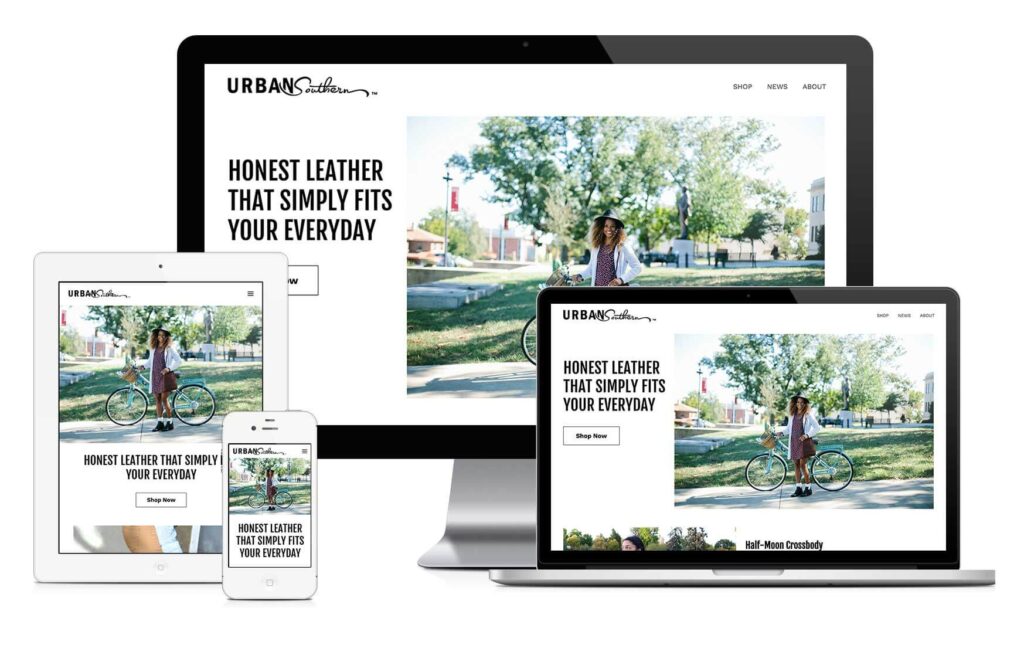
When we say marketing automation pays for itself, this is the story we’re usually thinking of. Urban Southern — a handmade leather goods brand run by two cousins — went from fewer than ten total sales on their old platform to a 900% sales lift, national press, $200K holiday months, and ultimately an acquisition. Here’s the actual playbook, because every piece of it is reusable.
The starting point: great product, dead platform
Regina Bauman made beautiful leather bags. That was never the problem. The problem was everything around the bags: a proprietary e-commerce platform that had produced fewer than ten sales in two years, a vanished freelancer, and — the detail that made it sporting — Black Friday only weeks away when her cousin Meg called us.
Worth pausing on, because it’s the most common e-commerce situation we see: the product is proven (people who found the bags loved the bags), the founder is capable, and the platform is silently strangling both. If your store “doesn’t work” but your product does, you’re probably standing where Regina stood.
Move one: a foundation that could take weight
We rebuilt on WordPress + WooCommerce — custom theme, stable managed hosting, and page-builder flexibility so Meg could ship campaign landing pages herself without a developer in the loop. That last clause matters more than the tech stack: the platform’s job was to keep up with their marketing instincts, not gatekeep them. (It’s the same ownership logic from our WordPress-vs-Shopify breakdown — when marketing agility is the differentiator, own the platform.)
Move two: warm the audience before asking
Here’s the part most replatforming stories skip — the launch marketing. Urban Southern had an email list of interested people who’d never been given a reason to act. In the weeks before Black Friday we warmed that list deliberately: emails seeding the upcoming sale, cross-promotion on Instagram, and a newsletter signup incentive (a one-time 10% discount) that grew the audience while the clock ran. No single email was clever. The sequence was the machine.
The weekend the math changed
Black Friday weekend: roughly 200 orders and over $10,000 in sales — against fewer than ten sales in the previous two years. Regina’s biggest complaint was packing all the inventory that had been gathering dust. Two Christmases later the brand moved over $200K of merchandise in a single month, got featured on Fox Business, and shortly after that, an entrepreneur acquired the business. From side hustle to exit in just over two years.
What the 900% was actually made of
No single trick. The lift decomposes into four ordinary parts, compounding:
- A platform that converts — fast, trustworthy checkout instead of a dead end.
- An audience treated like an asset — the list warmed, segmented, and grown on purpose.
- Marketing velocity — landing pages and promotions shipped in hours by the owners themselves.
- Compounding season over season — each campaign building list, proof, and repeat buyers for the next one.
Notice what’s absent: paid-ads heroics, viral moments, luck. This is plumbing plus discipline — which is precisely why it transfers. We’ve since run variations of the same play for other brands (the Jacket Society wiring job — +30% sales from automation alone — is this playbook’s second act).
What we’d add doing it again today
The Urban Southern build predates some machinery we’d now consider standard, so a 2026 version of this playbook gets three additions. Abandoned-cart recovery from day one — the highest-ROI automation in commerce, and exactly the kind of revenue a young brand can’t afford to leave on the table. Behavior-driven segmentation instead of one-list-fits-all sends: buyers, browsers, and the gone-quiet each get their own treatment automatically. And analytics wired to decisions — knowing which campaign actually produced orders, not just traffic, so each season’s budget learns from the last one.
None of that changes the lesson; it compounds it. The foundation-audience-velocity loop is the engine, and modern automation is a turbocharger bolted onto it. Brands that run the full stack today see the compounding arrive faster than Urban Southern’s two-year arc — the tooling caught up to the playbook.
The transferable question
If you sell online, the Urban Southern question is: which of the four parts is your bottleneck — platform, audience, velocity, or compounding? One of them is. The full case study with the founders’ own telling is here, the practice that builds this machinery is here, and if you want us to find your bottleneck specifically, a free systems review is where every one of these stories started.